WestwalkOrtho.com - Westwalk Orthodontic Group, P.C.


Westwalk Orthodontic Group, P.C. - Orthodontics and Dentofacial Orthopedics for Adults and Children

WestwalkOrtho.com Home >> FAQ


  1. How much does orthodontic treatment cost?

  2. Can braces be removed for special occasions such as Bat Mitzvah’s, Bar Mitzvah's, weddings, etc.?

  3. Do you offer a variety of payment options?

  4. Is it necessary to remove permanent teeth to straighten my child’s teeth?

  5. Isn’t it too early to straighten teeth if all the permanent teeth haven’t come in?

  6. I am a professional person who deals with the public and I’d be very self-conscious about wearing braces.  Do you use braces that aren’t especially noticeable?

  7. My dentist sent me to you because I have several missing teeth.  Why does he think I should wear braces?  My teeth look fairly straight so what is the reason?

  8. I’ve been told that my teeth can’t be straightened with braces alone.  According to my dentist, my teeth can be straightened, but I will also need some extensive surgery along with wearing braces.  What does this involve?

  9. I’ve been having pain my face and jaws and my dentist said I probably have "TMJ" problems.  What does this mean?

  10. Will my health insurance cover the cost of orthodontic treatment?

  11. After the braces are removed, how long do I have to wear retainers?

  12. How do I know when my child should see an Orthodontist?

  13. We have seen advertisements on TV for straightening teeth without using braces called Invisalign -- what is this and does it work?

  14. Is the 'INVISALIGN'™ technology without substantial problems?

  15. Can a problem that requires extraction of teeth to compensate for inadequate space be treated with this technique?


How much does orthodontic treatment cost?

Fees for treatment and diagnosis vary with the difficulty of the problem and time required to treat it. For example, a full treatment with all permanent teeth erupted with substantial protrusion and crowding may take between eighteen (18) and twenty—eight (28) months to complete. Total fee for this treatment would be $7870.00. The treatment portion of this fee is normally budgeted with an initial fee at the time of appliance placement ($2230.00) and twenty-four monthly payments ($200 per month) ($7230.00 is allocated for treatment and $640.00 is allocated for exams and records.) This is an all-inclusive fee that covers the initial clinical examination and diagnostic records including all x-rays, study casts, photographs,  cephalometric analysis, and  treatment planning as well as the pre-treatment consultation.

There are treatments that can begin earlier when the child has a mixture of deciduous (baby) and permanent teeth. Usually, the treatment is done in two (2) phases. Phase I treatment usually lasts approximately nine (9) to twelve (12) months. The second phase may begin with in twelve (12) to twenty-four (24) months after the first phase has been completed. The fee for first phase treatment is approximately $4005.00 ($3365.00 is allocated to treatment and $640.00 is allocated for exams and records) and is initiated with an appliance fee($1365.00) and monthly payments for 10-12 months ($200.00 per month). Phase II treatment fees are integrated with the current full treatment fee giving consideration for the fee paid in Phase I.

Of course, fees vary depending on the degree of difficulty and can range from as low as $250.00 for a simple retainer to more than $9500.00 for treatment requiring a combination of orthodontics and surgery.

Can braces be removed for special occasions such as Bat Mitzvah’s, Bar Mitzvah’s, weddings, etc.?

Yes, the braces can be removed for special occasions and than replaced.  Usually the braces on the upper front teeth are removed, since these are the most visible.  This requires using new braces when replaced and requires additional time.  There is an additional cost for this service as a result of these factors.

Do you offer a variety of payment options?

Yes, we offer two additional payment options to the office payment plan described in question one.  First, if you decide to pay the entire fee in advance, we give a seven (7) percent bookkeeping credit for this advance payment.  Secondly, we utilize the Capital One Healthcare Financing, a bank sponsored plan.  With Capital One there is no down payment.  You can select a monthly payment that fits within your budget.  Your payments will never change with fixed interest rates of 7.99 percent.  There is never any prepayment penalty.  The application process is fast and confidential using their toll free number, 24 hours a day, 7 days a week.  There is even a plan up to sixty (60) months for multiple family members in treatment,  with one low monthly payment.  If you wish further information call their toll free number, which is 1-877-559-5050.  You can actually be approved in just minutes.

Is it necessary to remove permanent teeth to straighten my child’s teeth?

In cases where there is severe crowding of the front teeth or when teeth are sufficiently protruding to prevent normal lip closure and swallowing, it may be necessary to create space by extracting permanent teeth.  However, we find that in the majority of cases, removal of permanent teeth is not required for a successful result.

Isn’t it too early to straighten teeth if all the permanent teeth haven’t come in?

It is not always necessary to defer treatment until all permanent teeth have erupted.  There are problems, which in fact, can and should be addressed before all permanent teeth have erupted.  For example, if upper front teeth in an eight-year-old child are positioned behind the lower front teeth producing what we describe as "crossbites", this can and should be addressed as early as possible.  If you see a large opening between the upper and lower front teeth when the back teeth are in contact, we call this an “open bite”.  Frequently these open bites are the result of ongoing finger sucking and improper tongue position when swallowing.  Often a simple appliance to prevent finger and tongue habits can be place to correct such a problem.  If an upper jaw is narrower than the lower jaw you may frequently see crowding of the upper front teeth as well as a crossbite of the back teeth.  This can be corrected by expanding the upper jaw with a device called a Rapid-palatal expander sometimes called an “expander”.  When appropriate and successful, this can create additional space for permanent teeth which otherwise would not have room to erupt normally.

I am a professional person who deals with the public and I’d be very self-conscious about wearing braces.  Do you use braces that aren’t especially noticeable?

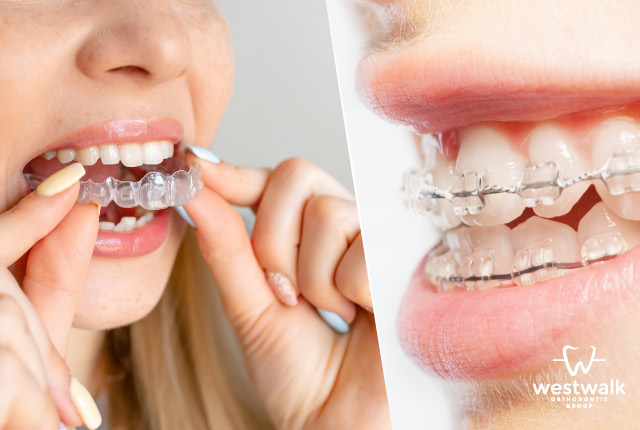
Yes, we have many adult patients who express the same feelings and we have available clear ceramic braces, which are very unobtrusive and work just as well as the conventional metal appliances.

My dentist sent me to you because I have several missing teeth.  Why does he think I should wear braces?  My teeth look fairly straight so what is the reason?

Very often people who have lost teeth and not had them replaced with fixed bridges or partial dentures have back teeth that have moved into positions that preclude the fabrication of sound replacements.  This usually is a result of poorly inclined positions.  It is usually necessary to upright these teeth before a proper bridge can be constructed.  Occasionally, spaces created by prematurely lost teeth can be closed precluding the need for any bridgework at all.  With the increasing practicality of bony implants, teeth adjacent to the unwanted space must have their roots separated sufficiently to allow proper implant placement.

I’ve been told that my teeth can’t be straightened with braces alone.  According to my dentist, my teeth can be straightened, but I will also need some extensive surgery along with wearing braces.  What does this involve?

In a small percentage of patients, teeth do not fit together properly because the supporting bone has grown unevenly.  In a still smaller group, there are visible facial asymmetries that are cosmetically unacceptable to the patients and cause improper bites.  When this situation is discovered, the orthodontist works with a highly trained oral-maxillofacial surgeon to formulate a treatment plan that addresses not only the fit of the teeth, but a repositioning of jaw structures which will provide a stable foundation for orthodontically repositioned teeth.  Usually there is a period that begins with the orthodontist aligning malpositioned teeth as preparation for the eventual surgery that may involve repositioning one or both jaws to bring the correctly positioned teeth into a proper fit.  This pre-surgical orthodontics can last from twelve (12) to eighteen (18) months.  When the case is ready for surgery, the patient is hospitalized for one to two days and leaves the hospital with upper and lower teeth fixated together.  In most instances, with modern rigid fixation of the moved jaw structures, this fixation lasts only about 1-2 weeks.  In fact, most patients after leaving the hospital can return to work or school within seven to ten days.  Surgical procedures are done within the mouth so that there are no visible marks upon the face.  Postoperative pain and swelling are usually minimal and the procedures themselves are done under a general anesthesia.   After  fixation  is removed, patients return to the orthodontist’s care for small finishing movements of the teeth that usually take from three to six months.  After braces are removed, the patient is given removable retainers to maintain the correction.  These are usually worn full-time for three to six months and then worn at night.  Usually the cost of the surgical procedure and hospitalization are covered by many insurance plans.

I’ve been having pain my face and jaws and my dentist said I probably have "TMJ" problems.  What does this mean?

The term "TMJ" is an abbreviation used to describe the joint at which the lower jaw connects to the skull, located just in front of each ear.  If there is actual damage within the joint itself, the problem is called Temporo-Mandibular Joint Syndrome.  Frequently, there is associated pain upon opening and closing when chewing, but this need not be present to fall into this category.  Occasionally this is due to an old injury caused by a blow to the lower jaw, perhaps sustained in a sports or automobile accident, even years before pain becomes evident.  However, the majority of patients that we see in our practice actually have no internal injury to the joint.  Their pain often can be related to “clenching”.  This constant clenching stresses the muscles to the point that they suffer a constant “spasm” which causes facial pain which can be ongoing and very annoying.  This condition is then referred to as M.P.D. or Myo-facial Pain Dysfunction syndrome.  This condition can become pervasive and until a diagnosis is made, patients can become very anxious about a potentially serious medical condition.  This anxiety only serves to increase their stress that further aggravates muscle spasm.  Very often, the use of very simple and inexpensive measures coupled with a clear explanation to the patient is all that is required to relieve the condition.  In more recalcitrant circumstances, over the counter pain relievers and home self-care procedures can produce relief very rapidly.  It is the identification and alleviation of stress that is the key in treating Myo-facial Pain.

Will my health insurance cover the cost of orthodontic treatment?

Many health insurance plans cover a portion of Orthodontic treatment.  Usually there is a deductible to pay and a co-payment amount with a lifetime maximum benefit.  Typically, the lifetime maximum is quite a bit lower than the full orthodontic fee.  If you have orthodontic coverage, we will provide forms for you to submit to your carrier.  We ask that you direct your company to pay you directly so that you are assured that you are receiving the exact amount to which you are entitled.  We then will submit a statement to you for the fee and you can apply the insurance proceeds toward the payment.

After the braces are removed, how long do I have to wear retainers?

Typically, we suggest that retainers are worn day and night for the first three to six months after appliances are removed.  After this period retainers are worn only at night for an additional three to six months.  Wear is further reduced at this time to every other night for a month, every third night for a month, then once a week for the final month.  In a few cases where we believe that stability on a long term basis may be a problem, we may continue some retention indefinitely, but these are fairly infrequent occurrences.

How do I know when my child should see an Orthodontist?

Because of the high quality of the majority of general dentists in this community, if you bring your child to regular dental visits from age 3, it is likely that your dentist will detect orthodontic problems at a very early age and make the appropriate referral.  However, if you see and suspect that the alignment of teeth looks abnormal, you should feel free to make an appointment for a clinical examination.

We have seen advertisements on TV for straightening teeth without using braces called Invisalign -- what is this and does it work?

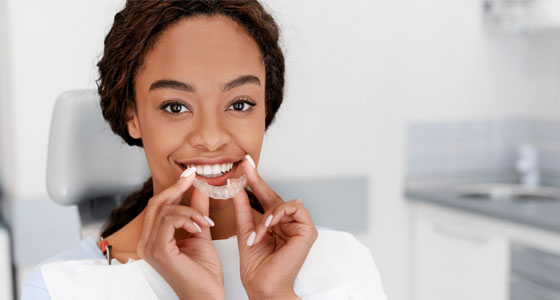
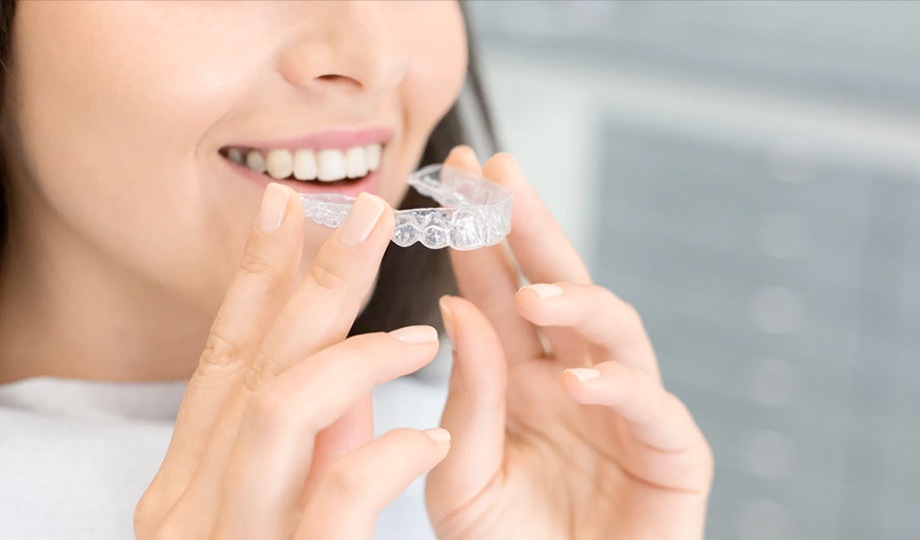
Unquestionably, many of you have seen the spot television advertisements for the "Invisible Braces Technique."  This is a technique that utilizes a series of thermoplastic clear removable appliances to align the teeth.  These aligners, as they are called are prepared by a computer cad-cam program based on special impressions taken in the orthodontic office. We have incorporated  this appliance therapy into our practice philosophy.  Invisalign is a patented appliance therapy of the Invisalign Corporation.  However, recently other companies have introduced thermoplastic removable appliances for aligning teeth. (After several court tests)  At present we have a  number of patients under treatment with these clear appliances from a number of companies including invisalign.

After using these appliances for several years we have  concluded that this method is  appropriate for relatively simple, uncomplicated situations. Problems with severe crowding, requiring tooth removal, or those with severe protrusions and deep bites do not respond to this type of therapy.  Additionally, because of the 22 hour per day wear demand we find that this technique lends itself primarily to adult treatment.  The cost of invisalign therapy is significantly higher than regular orthodontic therapy primarily because of the fees charged to the orthodontist by the invisalign corporation.

Is the 'INVISALIGN'™ technology without substantial problems?

According to recent reports, several of these cases have resulted in, "posterior open-bites" at their conclusion.  In simple terms this means that some or all of the back teeth do not come into contact upon closure of the jaws, which is annoying to say the least.  Is this a common occurrence?  Frankly, we cannot answer that question at this time due to insufficient data.

Can a problem that requires extraction of teeth to compensate for inadequate space be treated with this technique?

To be conservative, we believe that it would be very difficult to obtain a satisfactory result utilizing the Invisalign system.